Popular Workday-Pro-Integrations Exams - Workday-Pro-Integrations New Real Test
Wiki Article
BONUS!!! Download part of BraindumpsPrep Workday-Pro-Integrations dumps for free: https://drive.google.com/open?id=1w7teRmgoOKXKOlTDQ53vEqdwLSz4M2_-
The clients can try out and download our Workday-Pro-Integrations study materials before their purchase. They can immediately use our Workday-Pro-Integrations training guide after they pay successfully. And our expert team will update the Workday-Pro-Integrations study materials periodically after their purchase and if the clients encounter the problems in the course of using our Workday-Pro-Integrations Learning Engine our online customer service staff will enthusiastically solve their problems.
Workday Workday-Pro-Integrations Exam Syllabus Topics:
| Topic | Details |
|---|---|
| Topic 1 |
|
| Topic 2 |
|
| Topic 3 |
|
| Topic 4 |
|
| Topic 5 |
|
>> Popular Workday-Pro-Integrations Exams <<
Workday-Pro-Integrations New Real Test | Workday-Pro-Integrations PDF Dumps Files
Competition appear everywhere in modern society. There are many way to improve ourselves and learning methods of Workday-Pro-Integrations exams come in different forms. Economy rejuvenation and social development carry out the blossom of technology; some Workday-Pro-Integrations Learning Materials are announced which have a good quality. Certification qualification exam materials are a big industry and many companies are set up for furnish a variety of services for it.
Workday Pro Integrations Certification Exam Sample Questions (Q43-Q48):
NEW QUESTION # 43
This is the XML file generated from a Core Connector; Positions integration.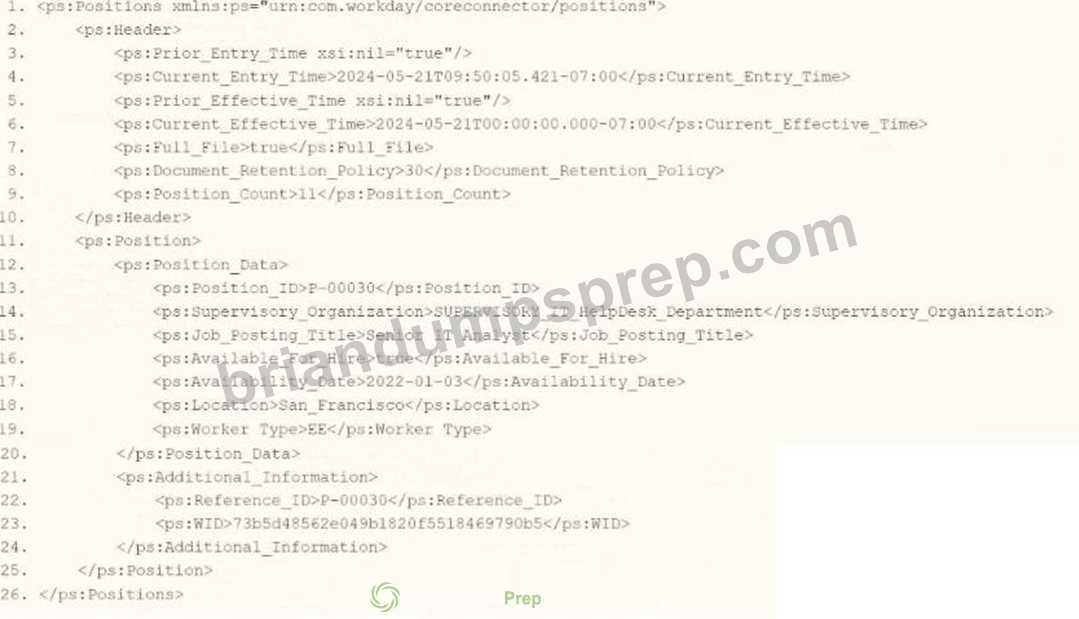
When performing an XSLT Transformation on the Core Connector: Positions XML output file, you want to show a hyperlink of positions that are not available for hiring as an entry in the Message tab.
What are all the needed ETV items to meet the above requirements?
- A.

- B.

- C.

- D.

Answer: B
Explanation:
In Workday integrations, the Extension for Transformation and Validation (ETV) framework is used within XSLT transformations to apply validation and formatting rules to XML data, such as the output from a Core Connector (e.g., Positions integration). In this scenario, you need to perform an XSLT transformation on the Core Connector: Positions XML output file to display a hyperlink for positions that are not available for hiring as an entry in the Message tab. This requires configuring ETV attributes to ensure the data is present and correctly targeted for the hyperlink.
Here's why option B is correct:
Requirement Analysis: The requirement specifies showing a hyperlink for positions "not available for hiring." In the provided XML, the ps:Available_For_Hire field under ps:Position_Data indicates whether a position is available for hire (e.g., <ps:Available_For_Hire>true</ps:Available_For_Hire>). For positions where this is false, you need to create a message (hyperlink) in the Message tab, which typically requires linking to a Workday ID (WID) or other identifier.
ETV Attributes:
etv:required="true": This ensures that the ps:WID value under ps:Additional_Information is mandatory for the transformation. If the WID is missing, the transformation will fail or generate an error, ensuring that the hyperlink can be created only for valid positions with an associated WID.
etv:target="[ps:Additional_Information/ps:WID]": This specifies that the target of the transformation (e.g., the hyperlink) should be the WID value found at ps:Additional_Information/ps:WID in the XML. This WID can be used to construct a hyperlink to the position in Workday, meeting the requirement to show a hyperlink for positions not available for hiring.
Context in XML: The XML shows ps:Additional_Information containing ps:WID (e.g., <ps:WID>73bd4d8562e04b1820f55818467905b</ps:WID>), which is a unique identifier for the position. By targeting this WID with etv:target, you ensure the hyperlink points to the correct position record in Workday when ps:Available_For_Hire is false.
Why not the other options?
A .
etv:minLength="0"
etv:targetWID="[ps:Additional_Information/ps:WID]"
etv:minLength="0" allows the WID to be empty or have zero length, which contradicts the need for a valid WID to create a hyperlink. It does not ensure the data is present, making it unsuitable. Additionally, etv:targetWID is not a standard ETV attribute; the correct attribute is etv:target, making this option incorrect.
C .
etv:minLength="0"
etv:target="[ps:Additional_Information/ps:WID]"
Similar to option A, etv:minLength="0" allows the WID to be empty, which does not meet the requirement for a mandatory WID to create a hyperlink. This makes it incorrect, as the hyperlink would fail if the WID is missing.
D .
etv:required="true"
etv:targetWID="[ps:Additional_Information/ps:WID]"
While etv:required="true" ensures the WID is present, etv:targetWID is not a standard ETV attribute. The correct attribute is etv:target, making this option syntactically incorrect and unsuitable for the transformation.
To implement this in XSLT for a Workday integration:
Use the ETV attributes from option B (etv:required="true" and etv:target="[ps:Additional_Information/ps:WID]") within your XSLT template to validate and target the ps:WID for positions where ps:Available_For_Hire is false. This ensures the transformation generates a valid hyperlink in the Message tab, linking to the position's WID in Workday.
:
Workday Pro Integrations Study Guide: Section on "ETV in XSLT Transformations" - Details the use of ETV attributes like required and target for validating and targeting data in Workday XML, including handling identifiers like WID for hyperlinks.
Workday Core Connector and EIB Guide: Chapter on "XML Transformations" - Explains how to use ETV attributes in XSLT to process position data, including creating messages or hyperlinks based on conditions like Available_For_Hire.
Workday Integration System Fundamentals: Section on "ETV for Message Generation" - Covers applying ETV attributes to generate hyperlinks in the Message tab, ensuring data integrity and correct targeting of Workday identifiers like WID.
NEW QUESTION # 44
Refer to the following scenario to answer the question below.
You have been asked to build an integration using the Core Connector: Worker template and should leverage the Data Initialization Service (DIS). The integration will be used to export a full file (no change detection) for employees only and will include personal data.
What configuration is required to ensure that only employees, and not contingent workers, are output by this integration?
- A. Configure the Integration Population Eligibility.
- B. Configure a map for worker type in the Integration Maps.
- C. Configure worker type in the Integration Field Attributes.
- D. Configure eligibility in the Integration Field Overrides.
Answer: A
Explanation:
The scenario involves a Core Connector: Worker integration using DIS to export a full file of personal data, restricted to employees only (excluding contingent workers). In Workday, the Worker business object includes both employees and contingent workers, so a filter is needed to limit the population. Let's explore the configuration:
* Requirement:Ensure the integration outputs only employees, not contingent workers. This is a population-level filter, not a field transformation or override.
* Integration Population Eligibility:In Core Connectors, theConfigure Integration Population Eligibilityrelated action defines which workers are included in the integration's dataset. You can set eligibility rules, such as "Worker Type equals Employee" (or exclude "Contingent Worker"), to filter the population before data is extracted. For a full file export (no change detection), this ensures the entire output is limited to employees.
* Option Analysis:
* A. Configure the Integration Population Eligibility: Correct. This filters the worker population to employees only, aligning with the requirement at the dataset level.
* B. Configure a map for worker type in the Integration Maps: Incorrect. Integration Maps transform field values (e.g., "Employee" to "EMP"), not filter the population of workers included in the extract.
* C. Configure worker type in the Integration Field Attributes: Incorrect. Integration Field Attributes refine how a field is output (e.g., phone type), not the overall population eligibility.
* D. Configure eligibility in the Integration Field Overrides: Incorrect. Integration Field Overrides replace field values with custom data (e.g., a calculated field), not define the population of workers.
* Implementation:
* Edit the Core Connector: Worker integration.
* Use the related actionConfigure Integration Population Eligibility.
* Add a rule: "Worker Type equals Employee" (or exclude "Contingent Worker").
* Save and test to ensure only employee data is exported.
References from Workday Pro Integrations Study Guide:
* Core Connectors & Document Transformation: Section on "Configuring Integration Population Eligibility" explains filtering the worker population for outbound integrations.
* Integration System Fundamentals: Discusses population scoping in Core Connectors to meet specific export criteria.
NEW QUESTION # 45
Refer to the following XML to answer the question below.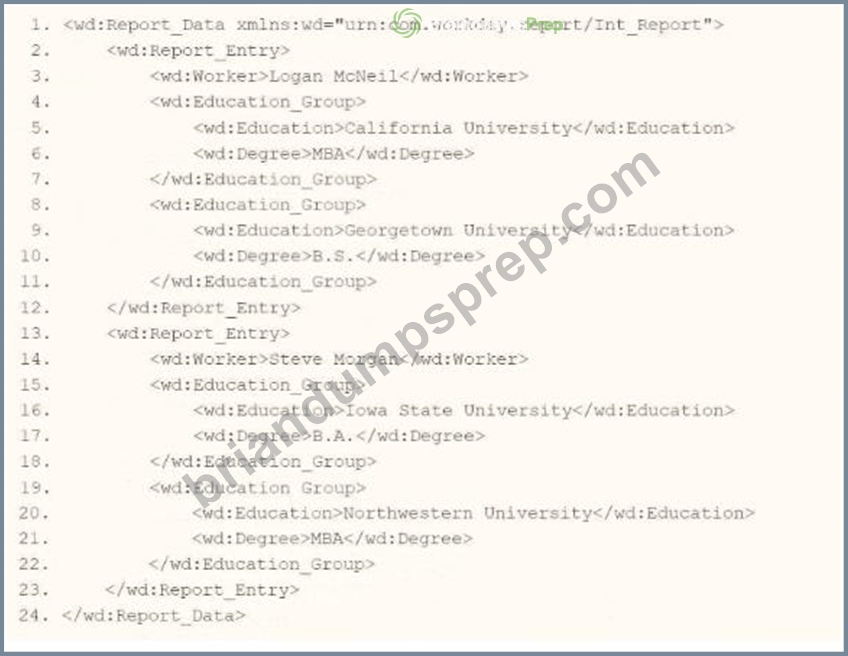
Within the template which matches on wd:Report_Entry, you would like to conditionally process the wd:Education_Group elements by using an <xsl:apply-templates> element. What XPath syntax would be used for the select to iterate over only the wd:Education_Group elements where the Degree is an MBA?
- A. wd:Report_Entry/wd:Education_Group[wd:Degree='MBA' 1:Degree='MBA']
- B. wd:Report_Entry/wd:Education_Group/ wd:Degree='MBA' 1:Degree='MBA'
- C. wd:Education_Group[wd:Degree='MBA']
- D. wd:Education_Group/wd:Degree='MBA'
Answer: C
Explanation:
In Workday integrations, XSLT is used to transform XML data, such as the output from a web service-enabled report or EIB, into a desired format for third-party systems. In this scenario, you need to write XSLT to process wd:Education_Group elements within a template matching wd:Report_Entry, using an <xsl:apply-templates> element to iterate only over wd:Education_Group elements where the wd:Degree is "MBA." The correct XPath syntax for the select attribute is critical to ensure accurate filtering.
Here's why option A is correct:
XPath Syntax In XPath, square brackets [ ] are used to specify predicates or conditions to filter elements. The condition wd:Degree='MBA' checks if the wd:Degree child element has the value "MBA." When applied to wd:Education_Group, the expression wd:Education_Group[wd:Degree='MBA'] selects only those wd:Education_Group elements that contain a wd:Degree child element with the value "MBA." Context in XSLT: Within an <xsl:apply-templates> element in a template matching wd:Report_Entry, the select attribute uses XPath to specify which nodes to process. This syntax ensures that the template only applies to wd:Education_Group elements where the degree is "MBA," aligning with the requirement to conditionally process only those specific education groups.
XML Structure Alignment: Based on the provided XML snippet, wd:Education_Group contains wd:Education and wd:Degree child elements (e.g., <wd:Degree>MBA</wd:Degree>). The XPath wd:Education_Group[wd:Degree='MBA'] correctly navigates to wd:Education_Group and filters based on the wd:Degree value, matching the structure and requirement.
Why not the other options?
B . wd:Education_Group/wd:Degree='MBA': This is not a valid XPath expression for a predicate. It attempts to navigate to wd:Degree as a child but does not use square brackets [ ] to create a filtering condition. This would be interpreted as selecting wd:Degree elements under wd:Education_Group, but it wouldn't filter based on the value "MBA" correctly within an <xsl:apply-templates> context.
C . wd:Report_Entry/wd:Education_Group/wd:Degree='MBA' 1:Degree='MBA': This is syntactically incorrect and unclear. It includes a malformed condition (1:Degree='MBA') and does not use proper XPath predicate syntax. It fails to filter wd:Education_Group elements based on wd:Degree='MBA' and is not valid for use in select.
D . wd:Report_Entry/wd:Education_Group[wd:Degree='MBA' 1:Degree='MBA']: This is also syntactically incorrect due to the inclusion of 1:Degree='MBA' within the predicate. The 1: prefix is not valid XPath syntax and introduces an error. The correct predicate should only be wd:Degree='MBA' to filter the wd:Education_Group elements.
To implement this in XSLT:
Within your template matching wd:Report_Entry, you would write an <xsl:apply-templates> element with the select attribute set to wd:Education_Group[wd:Degree='MBA']. This ensures that only wd:Education_Group elements with a wd:Degree value of "MBA" are processed by the corresponding templates, effectively filtering out other degrees (e.g., B.S., B.A.) in the transformation.
This approach ensures the XSLT transformation aligns with Workday's XML structure and integration requirements for processing education data in a report output.
:
Workday Pro Integrations Study Guide: Section on "XSLT Transformations for Workday Integrations" - Details the use of XPath in XSLT for filtering XML elements, including predicates for conditional processing based on child element values.
Workday EIB and Web Services Guide: Chapter on "XML and XSLT for Report Data" - Explains the structure of Workday XML (e.g., wd:Education_Group, wd:Degree) and how to use XPath to navigate and filter data.
Workday Reporting and Analytics Guide: Section on "Web Service-Enabled Reports" - Covers integrating report outputs with XSLT for transformations, including examples of filtering elements based on specific values like degree types.
NEW QUESTION # 46
Refer to the following XML to answer the question below.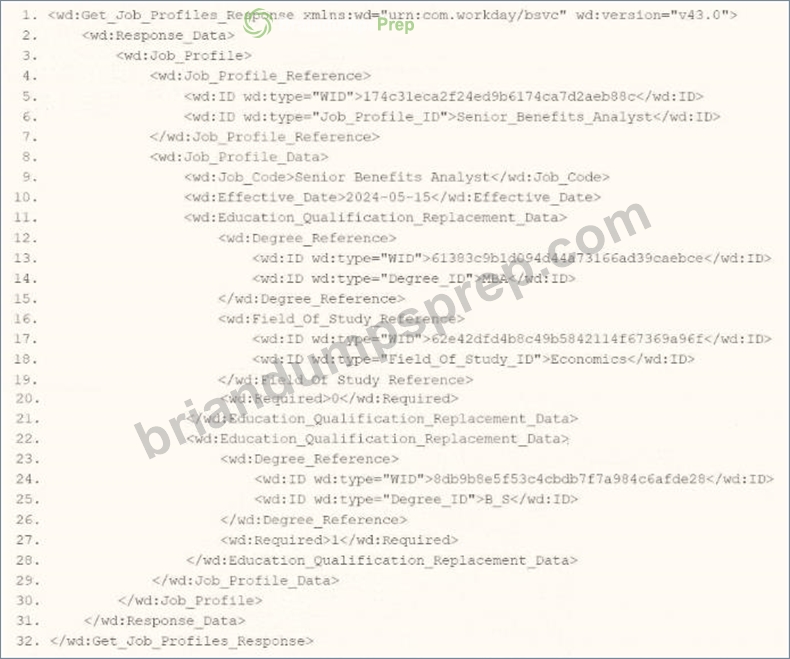
You are an integration developer and need to write XSLT to transform the output of an EIB which is making a request to the Get Job Profiles web service operation. The root template of your XSLT matches on the <wd:Get_Job_Profiles_Response> element. This root template then applies a template against <wd:Job_Profile>.
What XPath syntax would be used to select the value of the wd:Job_Code element when the <xsl:value-of> element is placed within the template which matches on <wd:Job_Profile>?
- A. wd:Job_Profile_Data/wd:Job_Code
- B. wd:Job_Profile_Reference/wd:ID[@wd:type='Job_Profile_ID']
- C. wd:Job_Profile/wd:Job_Profile_Data/wd:Job_Code
- D. wd:Job_Profile_Data[@wd:Job_Code]
Answer: A
Explanation:
As an integration developer working with Workday, you are tasked with transforming the output of an Enterprise Interface Builder (EIB) that calls the Get_Job_Profiles web service operation. The provided XML shows the response from this operation, and you need to write XSLT to select the value of the <wd:Job_Code> element. The root template of your XSLT matches on <wd:Get_Job_Profiles_Response> and applies a template to <wd:Job_Profile>. Within this template, you use the <xsl:value-of> element to extract the <wd:Job_Code> value. Let's analyze the XML structure, the requirement, and each option to determine the correct XPath syntax.
Understanding the XML and Requirement
The XML snippet provided is a SOAP response from the Get_Job_Profiles web service operation in Workday, using the namespace xmlns:wd="urn:com.workday/bsvc" and version wd:version="v43.0". Key elements relevant to the question include:
The root element is <wd:Get_Job_Profiles_Response>.
It contains <wd:Response_Data>, which includes <wd:Job_Profile> elements.
Within <wd:Job_Profile>, there are:
<wd:Job_Profile_Reference>, which contains <wd:ID> elements (e.g., a Job_Profile_ID).
<wd:Job_Profile_Data>, which contains <wd:Job_Code> with the value Senior_Benefits_Analyst.
The task is to select the value of <wd:Job_Code> (e.g., "Senior_Benefits_Analyst") using XPath within an XSLT template that matches <wd:Job_Profile>. The <xsl:value-of> element outputs the value of the selected node, so you need the correct XPath path from the <wd:Job_Profile> context to <wd:Job_Code>.
Analysis of Options
Let's evaluate each option based on the XML structure and XPath syntax rules:
Option A: wd:Job_Profile/wd:Job_Profile_Data/wd:Job_Code
This XPath starts from wd:Job_Profile and navigates to wd:Job_Profile_Data/wd:Job_Code. However, in the XML, <wd:Job_Profile> is the parent element, and <wd:Job_Profile_Data> is a direct child containing <wd:Job_Code>. The path wd:Job_Profile/wd:Job_Profile_Data/wd:Job_Code is technically correct in terms of structure, as it follows the hierarchy:
<wd:Job_Profile> → <wd:Job_Profile_Data> → <wd:Job_Code>.
However, since the template matches <wd:Job_Profile>, the context node is already <wd:Job_Profile>. You don't need to include wd:Job_Profile/ at the beginning of the XPath unless navigating from a higher level. Starting directly with wd:Job_Profile_Data/wd:Job_Code (Option C) is more concise and appropriate for the context. This option is technically valid but redundant and less efficient, making it less preferred compared to Option C.
Option B: wd:Job_Profile_Data[@wd:Job_Code]
This XPath uses an attribute selector ([@wd:Job_Code]) to filter <wd:Job_Profile_Data> based on an attribute named wd:Job_Code. However, examining the XML, <wd:Job_Profile_Data> does not have a wd:Job_Code attribute-it has a child element <wd:Job_Code> with the value "Senior_Benefits_Analyst." The [@attribute] syntax is used for attributes, not child elements, so this XPath is incorrect. It would not select the <wd:Job_Code> value and would likely return no results or an error. This option is invalid.
Option C: wd:Job_Profile_Data/wd:Job_Code
This XPath starts from wd:Job_Profile_Data (a direct child of <wd:Job_Profile>) and navigates to wd:Job_Code. Since the template matches <wd:Job_Profile>, the context node is <wd:Job_Profile>, and wd:Job_Profile_Data/wd:Job_Code correctly points to the <wd:Job_Code> element within <wd:Job_Profile_Data>. This path is:
Concise and appropriate for the context.
Directly selects the value "Senior_Benefits_Analyst" when used with <xsl:value-of>.
Matches the XML structure, as <wd:Job_Profile_Data> contains <wd:Job_Code> as a child.
This is the most straightforward and correct option for selecting the <wd:Job_Code> value within the <wd:Job_Profile> template.
Option D: wd:Job_Profile_Reference/wd:ID[@wd:type='Job_Profile_ID']
This XPath navigates to <wd:Job_Profile_Reference> (a child of <wd:Job_Profile>) and then to <wd:ID> with an attribute wd:type="Job_Profile_ID". In the XML, <wd:Job_Profile_Reference> contains:
<wd:ID wd:type="WID">1740d3eca2f2ed9b6174ca7d2ae88c8c</wd:ID>
<wd:ID wd:type="Job_Profile_ID">Senior_Benefits_Analyst</wd:ID>
The XPath wd:Job_Profile_Reference/wd:ID[@wd:type='Job_Profile_ID'] selects the <wd:ID> element with wd:type="Job_Profile_ID", which has the value "Senior_Benefits_Analyst." However, this is not the <wd:Job_Code> value-the <wd:Job_Code> is a separate element under <wd:Job_Profile_Data>, not <wd:Job_Profile_Reference>. The question specifically asks for the <wd:Job_Code> value, so this option is incorrect, as it selects a different piece of data (the job profile ID, not the job code).
Why Option C is Correct
Option C, wd:Job_Profile_Data/wd:Job_Code, is the correct XPath syntax because:
It starts from the context node <wd:Job_Profile> (as the template matches this element) and navigates to <wd:Job_Profile_Data/wd:Job_Code>, which directly selects the <wd:Job_Code> element's value ("Senior_Benefits_Analyst").
It is concise and aligns with standard XPath navigation in XSLT, avoiding unnecessary redundancy (unlike Option A) or incorrect attribute selectors (unlike Option B).
It matches the XML structure, where <wd:Job_Profile_Data> is a child of <wd:Job_Profile> and contains <wd:Job_Code> as a child.
When used with <xsl:value-of select="wd:Job_Profile_Data/wd:Job_Code"/> in the template, it outputs the job code value, fulfilling the requirement.
Practical Example in XSLT
Here's how this might look in your XSLT:
xml
WrapCopy
<xsl:template match="wd:Job_Profile">
<xsl:value-of select="wd:Job_Profile_Data/wd:Job_Code"/>
</xsl:template>
This would output "Senior_Benefits_Analyst" for the <wd:Job_Code> element in the XML.
Verification with Workday Documentation
The Workday Pro Integrations Study Guide and SOAP API Reference (available via Workday Community) detail the structure of the Get_Job_Profiles response and how to use XPath in XSLT for transformations. The XML structure shows <wd:Job_Profile_Data> as the container for job profile details, including <wd:Job_Code>. The guide emphasizes using relative XPath paths within templates to navigate from the matched element (e.g., <wd:Job_Profile>) to child elements like <wd:Job_Profile_Data/wd:Job_Code>.
Workday Pro Integrations Study Guide Reference
Section: XSLT Transformations in EIBs - Describes using XSLT to transform web service responses, including selecting elements with XPath.
Section: Workday Web Services - Details the Get_Job_Profiles operation and its XML output structure, including <wd:Job_Profile_Data> and <wd:Job_Code>.
Section: XPath Syntax - Explains how to navigate XML hierarchies in Workday XSLT, using relative paths like wd:Job_Profile_Data/wd:Job_Code from a <wd:Job_Profile> context.
Workday Community SOAP API Reference - Provides examples of XPath navigation for Workday web service responses.
Option C is the verified answer, as it correctly selects the <wd:Job_Code> value using the appropriate XPath syntax within the <wd:Job_Profile> template context.
NEW QUESTION # 47
Refer to the following XML to answer the question below.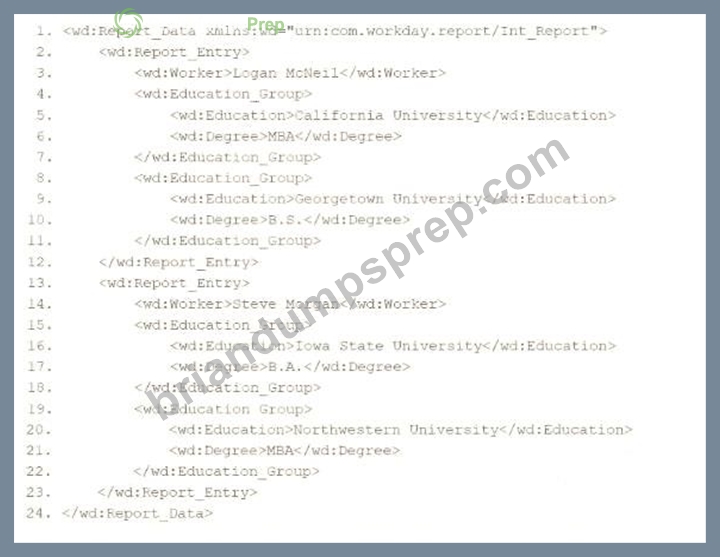
Within the template which matches on wd:Report_Entry, you would like to conditionally process the wd:
Education_Group elements by using an <xsl:apply-templates> element. What XPath syntax would be used for the select to iterate over only the wd:Education_Group elements where the Degree is an MBA?
- A. wd:Report_Entry/wd:Education_Group[wd:Degree='MBA' 1:Degree='MBA']
- B. wd:Report_Entry/wd:Education_Group/ wd:Degree='MBA' 1:Degree='MBA'
- C. wd:Education_Group[wd:Degree='MBA']
- D. wd:Education_Group/wd:Degree='MBA'
Answer: C
Explanation:
In Workday integrations, XSLT is used to transform XML data, such as the output from a web service- enabled report or EIB, into a desired format for third-party systems. In this scenario, you need to write XSLT to process wd:Education_Group elements within a template matching wd:Report_Entry, using an <xsl:apply- templates> element to iterate only over wd:Education_Group elements where the wd:Degree is "MBA." The correct XPath syntax for the select attribute is critical to ensure accurate filtering.
Here's why option A is correct:
* XPath Syntax Explanation: In XPath, square brackets [ ] are used to specify predicates or conditions to filter elements. The condition wd:Degree='MBA' checks if the wd:Degree child element has the value
"MBA." When applied to wd:Education_Group, the expression wd:Education_Group[wd:
Degree='MBA'] selects only those wd:Education_Group elements that contain a wd:Degree child element with the value "MBA."
* Context in XSLT: Within an <xsl:apply-templates> element in a template matching wd:Report_Entry, the select attribute uses XPath to specify which nodes to process. This syntax ensures that the template only applies to wd:Education_Group elements where the degree is "MBA," aligning with the requirement to conditionally process only those specific education groups.
* XML Structure Alignment: Based on the provided XML snippet, wd:Education_Group contains wd:
Education and wd:Degree child elements (e.g., <wd:Degree>MBA</wd:Degree>). The XPath wd:
Education_Group[wd:Degree='MBA'] correctly navigates to wd:Education_Group and filters based on the wd:Degree value, matching the structure and requirement.
Why not the other options?
* B. wd:Education_Group/wd:Degree='MBA': This is not a valid XPath expression for a predicate. It attempts to navigate to wd:Degree as a child but does not use square brackets [ ] to create a filtering condition. This would be interpreted as selecting wd:Degree elements under wd:Education_Group, but it wouldn't filter based on the value "MBA" correctly within an <xsl:apply-templates> context.
* C. wd:Report_Entry/wd:Education_Group/wd:Degree='MBA' 1:Degree='MBA': This is syntactically incorrect and unclear. It includes a malformed condition (1:Degree='MBA') and does not use proper XPath predicate syntax. It fails to filter wd:Education_Group elements based on wd:Degree='MBA' and is not valid for use in select.
* D. wd:Report_Entry/wd:Education_Group[wd:Degree='MBA' 1:Degree='MBA']: This is also syntactically incorrect due to the inclusion of 1:Degree='MBA' within the predicate. The 1: prefix is not valid XPath syntax and introduces an error. The correct predicate should only be wd:Degree='MBA' to filter the wd:Education_Group elements.
To implement this in XSLT:
* Within your template matching wd:Report_Entry, you would write an <xsl:apply-templates> element with the select attribute set to wd:Education_Group[wd:Degree='MBA']. This ensures that only wd:
Education_Group elements with a wd:Degree value of "MBA" are processed by the corresponding templates, effectively filtering out other degrees (e.g., B.S., B.A.) in the transformation.
This approach ensures the XSLT transformation aligns with Workday's XML structure and integration requirements for processing education data in a report output.
Workday Pro Integrations Study Guide: Section on "XSLT Transformations for Workday Integrations" - Details the use of XPath in XSLT for filtering XML elements, including predicates for conditional processing based on child element values.
Workday EIB and Web Services Guide: Chapter on "XML and XSLT for Report Data" - Explains the structure of Workday XML (e.g., wd:Education_Group, wd:Degree) and how to use XPath to navigate and filter data.
Workday Reporting and Analytics Guide: Section on "Web Service-Enabled Reports" - Covers integrating report outputs with XSLT for transformations, including examples of filtering elements based on specific values like degree types.
NEW QUESTION # 48
......
Our Workday Pro Integrations Certification Exam study question has high quality. So there is all effective and central practice for you to prepare for your test. With our professional ability, we can accord to the necessary testing points to edit Workday-Pro-Integrations exam questions. It points to the exam heart to solve your difficulty. So high quality materials can help you to pass your exam effectively, make you feel easy, to achieve your goal. With the Workday-Pro-Integrations Test Guide use feedback, it has 98%-100% pass rate. That’s the truth from our customers. And it is easy to use for you only with 20 hours’ to 30 hours’ practice. After using the Workday-Pro-Integrations test guide, you will have the almost 100% assurance to take part in an examination. With high quality materials and practices, you will get easier to pass the exam.
Workday-Pro-Integrations New Real Test: https://www.briandumpsprep.com/Workday-Pro-Integrations-prep-exam-braindumps.html
- Preparation Material with Free Demos and Updates [2026] ???? Search for ▶ Workday-Pro-Integrations ◀ on ▛ www.vce4dumps.com ▟ immediately to obtain a free download ➡Real Workday-Pro-Integrations Dumps
- Workday Integrations Workday-Pro-Integrations pdf braindumps - Workday-Pro-Integrations practice exam test ???? Search for ☀ Workday-Pro-Integrations ️☀️ and easily obtain a free download on ⏩ www.pdfvce.com ⏪ ????Workday-Pro-Integrations Latest Study Plan
- Workday-Pro-Integrations exam preparatory: Workday Pro Integrations Certification Exam - Workday-Pro-Integrations exam torrent ???? Download ⏩ Workday-Pro-Integrations ⏪ for free by simply entering 【 www.validtorrent.com 】 website ????Latest Workday-Pro-Integrations Braindumps Sheet
- Workday-Pro-Integrations Latest Study Plan ⬜ Instant Workday-Pro-Integrations Discount ⏮ Workday-Pro-Integrations Latest Study Plan ???? Search for 「 Workday-Pro-Integrations 」 and download exam materials for free through ( www.pdfvce.com ) ????Original Workday-Pro-Integrations Questions
- Workday-Pro-Integrations Pass4sure ???? Workday-Pro-Integrations Certification Test Questions ???? New Workday-Pro-Integrations Test Question ???? Go to website ➠ www.prep4away.com ???? open and search for ( Workday-Pro-Integrations ) to download for free ????Workday-Pro-Integrations Latest Study Plan
- Popular Workday-Pro-Integrations Exams - Workday Pro Integrations Certification Exam Realistic New Real Test Pass Guaranteed ⛰ Search on 「 www.pdfvce.com 」 for ➤ Workday-Pro-Integrations ⮘ to obtain exam materials for free download ????Detailed Workday-Pro-Integrations Answers
- Study Workday-Pro-Integrations Reference ⛺ Workday-Pro-Integrations Practice Tests ???? Workday-Pro-Integrations Reliable Exam Book ???? Enter { www.validtorrent.com } and search for ⏩ Workday-Pro-Integrations ⏪ to download for free ????New Workday-Pro-Integrations Test Question
- Study Workday-Pro-Integrations Reference ???? New Workday-Pro-Integrations Test Question ???? Workday-Pro-Integrations Pass4sure Study Materials ???? Search for ▷ Workday-Pro-Integrations ◁ and easily obtain a free download on { www.pdfvce.com } ▛Real Workday-Pro-Integrations Dumps
- Workday-Pro-Integrations Pass4sure ???? Study Workday-Pro-Integrations Reference ???? Workday-Pro-Integrations Key Concepts ???? Search for ▛ Workday-Pro-Integrations ▟ and download exam materials for free through ⇛ www.pass4test.com ⇚ ????Workday-Pro-Integrations High Quality
- Workday-Pro-Integrations Pass4sure ???? Workday-Pro-Integrations Pass4sure Study Materials ???? Workday-Pro-Integrations Certification Test Questions ???? Download 《 Workday-Pro-Integrations 》 for free by simply entering ✔ www.pdfvce.com ️✔️ website ????Workday-Pro-Integrations Practice Tests
- Workday-Pro-Integrations Best Practice Exam - Workday-Pro-Integrations Reliable Soft Simulations - Workday-Pro-Integrations New Study Questions Pdf ???? The page for free download of ▛ Workday-Pro-Integrations ▟ on ☀ www.dumpsquestion.com ️☀️ will open immediately ????Workday-Pro-Integrations Reliable Exam Book
- jadasqen772328.wikilima.com, kobickuj931693.blognody.com, haseebaumk612047.wikilowdown.com, gerardcdng965797.cosmicwiki.com, nanniejfgc774861.bloggip.com, gerardmlnt032517.wikiap.com, neilhgnp487994.59bloggers.com, brianlkkn580518.activablog.com, abelfcmx286221.blogsuperapp.com, marciybd784267.wikifordummies.com, Disposable vapes
P.S. Free & New Workday-Pro-Integrations dumps are available on Google Drive shared by BraindumpsPrep: https://drive.google.com/open?id=1w7teRmgoOKXKOlTDQ53vEqdwLSz4M2_-
Report this wiki page